재고가 있는 Metalon® 전도성 잉크와 인쇄 키트는 24시간 이내에 배송됩니다!

Printed Interdigitated Electrodes as a Sensor Backbone

The role of NovaCentrix Metalon® HPS-021LV as a stable, screen-printable electrical backbone for printed sensing platforms across pressure, humidity, impedance, and wearable biointerfaces.

1. 개요

Printed sensors are now foundational across flexible electronics, wearables, environmental monitoring, and human-machine interfaces. While the active sensing layer usually gets the attention, device performance and scalability depend just as heavily on the printed electrode platform beneath it.

In many printed sensor architectures, interdigitated electrodes serve as the passive electrical backbone. They do not create selectivity or sensitivity directly. Instead, they provide a stable and repeatable electrical interface between the sensing layer and the readout electronics.

2. Interdigitated Electrodes in Printed Sensors

2.1 What IDEs do and what they do not do

Printed IDEs define electric field geometry, collect electrical signals, interface with external electronics, and provide mechanical and electrical stability. The active sensing layer, by contrast, responds to pressure, humidity, gas, bio-potential, or analyte exposure and drives the measurable resistance, capacitance, or impedance change.

2.2 Why interdigitated geometry is widely used

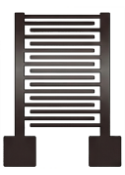
Interdigitated layouts maximize electrode interaction area in a compact footprint, create strong surface-confined fields, enable multiple sensing modes, and allow performance tuning through geometry instead of material changes alone.

3. Requirements for Conductive Inks Used in IDEs

  • Consistent line definition and edge fidelity
  • Stable electrical properties across temperature, humidity, and cycling
  • Strong adhesion to flexible substrates
  • Compatibility with low-temperature curing
  • Mechanical robustness under bending and handling
  • Repeatability across batches and print runs

4. 메탈론® HPS-021LV as a Reference Ink for Printed IDEs

메탈론® HPS-021LV is a silver flake, screen-printable conductive ink designed for printed electronics on polymer substrates. In sensing applications, it is commonly treated as a reference electrode material rather than an experimental variable. [1], [2], [6]

Key attributes include screen-print-optimized rheology, reliable conductivity for resistive, capacitive, and impedance sensing, compatibility with PET, PMMA, paper, and other flexible materials, and proven low-temperature curing performance. [1], [2], [4], [6]

5. Electrode Geometry as a Performance Lever

Published studies show that with the sensing layer held constant, sensor performance can vary significantly based only on electrode geometry. Finger width, spacing, and layout choices such as interdigital, serpentine, meander, or spiral structures can change sensitivity by several fold. That makes repeatable conductive ink behavior essential. [2], [5], [6]

6. Manufacturing and Scalability Considerations

  • IDE designs can be standardized and reused
  • Sensing layers can be iterated without redesigning electrodes
  • Process development is simplified
  • Transition from lab-scale to pilot-scale manufacturing is accelerated

7. Academic Validation from Published Sensing Platforms

7.1 Mechanical pressure and touch sensing

HPS-021LV screen printed IDEs are used beneath resistive pressure and touch sensing layers as passive signal-collection electrodes, while the sensing layers control sensitivity, hysteresis, and cycling stability. [3], [4], [5]

7.2 Scalable and matrix-addressed sensor arrays

Printed IDEs are integrated into addressable pressure sensor arrays where the electrode layout remains stable while sensing materials and array architectures are varied. [5]

7.3 Flexible and conformal sensing interfaces

HPS-021LV has been validated on flexible PET, paper, and PMMA-based sensing structures where conformability, stable electrical response, and repeatable printed geometry are required for practical sensor integration. [2], [4], [6]

7.4 Capacitive and impedance-based sensing

In humidity and impedance sensors, IDE geometry controls field distribution and frequency response while the active layer defines dielectric or ionic behavior, again positioning the conductive ink as stable infrastructure. [1], [2], [6]

8. 요약 및 주요 내용

  • IDEs act as the electrical backbone of printed sensors
  • The sensing function resides in the active material, not the electrodes
  • Electrode geometry strongly influences sensitivity and signal quality
  • Stable, manufacturable conductive inks are essential for scalable sensor development

9. NovaCentrix 소개

NovaCentrix develops conductive inks, nanomaterials, and advanced materials solutions for printed and flexible electronics. Through collaboration with academic and industrial partners, NovaCentrix materials support sensing, energy, electronics, and emerging application areas.

10. 참고자료

  1. [1]

    Kostic, et al. Multifunctional Screen-Printed TiO2 Nanoparticles Tuned by Laser Irradiation for a Flexible and Scalable UV Detector and Room-Temperature Ethanol Sensor. ACS Appl. Mater. Interfaces 2019.

    오픈 소스
  2. [2]

    Stanojkovic, et al. Laser-Tunable Printed ZnO Nanoparticles for Paper-Based UV Sensors with Reduced Humidity Interference. Nanomaterials 2020.

    오픈 소스
  3. [3]

    Meira, et al. Sustainable Collagen Blends with Different Ionic Liquids for Resistive Touch Sensing Applications. ACS Sustainable Chem. Eng. 2023.

    오픈 소스
  4. [4]

    Andonegi, et al. Sustainable Collagen Composites with Graphene Oxide for Bending Resistive Sensing. Polymers 2023.

    오픈 소스
  5. [5]

    Andonegi, et al. Biodegradable and Biocompatible Collagen-Based Hybrid Materials for Force Sensing Applications. Int. J. Biol. Macromol. 2024.

    오픈 소스
  6. [6]

    Suh, et al. Laser Ablation Assisted Micropattern Screen Printed Transduction Electrodes for Sensing Applications. Sci. Rep. 2022.

    오픈 소스