Following the successful launch of our inaugural newsletter, we are pleased to present the second issue of our Quarterly Technical Update. This quarter has been defined by a remarkable shift from technical validation to scaled implementation, evidenced by historic growth in both our materials revenue and global shipments. As our materials move deeper into production workflows, we remain committed to sharing the “why” behind the “what” and exploring the technical nuances that allow printed electronics to perform in increasingly demanding environments.
In this issue, we dive into the diverse ways NovaCentrix technologies are enabling cross-disciplinary innovation. We highlight recent academic breakthroughs, and we provide an exclusive look at our upcoming Metalon® Platinum Ink. Developed for the extreme thermal requirements of the aerospace sector, this new platform underscores our focus on expanding the functional limits of additive manufacturing. Whether you are working in a research lab or on a high-volume assembly line, we hope these insights continue to foster the technical dialogue necessary to solve your most complex material challenges.
Product Spotlight: Expanding the Metalon® Suite with High-Temp Platinum
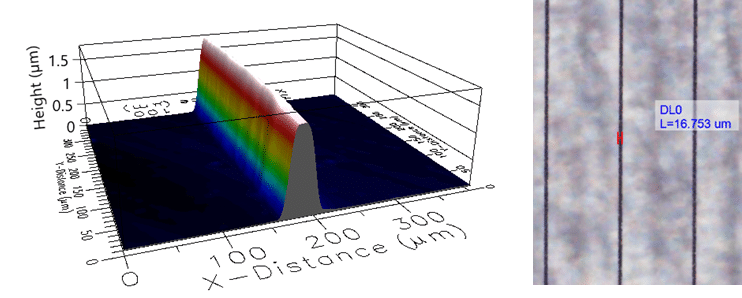
We are pleased to announce the upcoming Q2 launch of our new Metalon® Platinum Ink. This formulation, optimized for Aerosol printing, represents a significant leap forward for extreme-environment electronics. During recent validation, our platinum formulation demonstrated exceptional stability over many hours of continuous jetting and a much-reduced setup time. Capable of achieving ultra-fine line widths (< 15 microns), this ink maintains its integrity from initial print through high-temperature processing. While typical curing occurs at temperatures as low as 200°C, the material excels at temperatures up to 1100°C on alumina substrates, resulting in dense, high-purity metallic films ideally suited for the rigors of aerospace and turbine environments.
Beyond its mechanical robustness, the development of this ink has been driven by real-world application needs, specifically for high-temperature strain gauges in the aerospace sector.
As we move toward the official release, we are also seeing strong interest from the biomedical community for thin-film platinum electrode coatings and implantable sensors. Look for the full Technical Data Sheet (TDS) and official website launch later this quarter.
Business Highlights
NovaCentrix continues to demonstrate strong operational momentum as we enter the second quarter of 2026, driven by a deepening integration of our materials into both high-tech manufacturing and cutting-edge academic research. This quarter marked several historic milestones for the company: February was the highest revenue month in NovaCentrix’s history for materials, followed immediately by March recording our largest number of monthly shipments to date. These achievements reflect a significant shift from small-scale experimentation to the consistent, high-volume use of our inks within customer production workflows.
This sustained activity reinforces our commitment to providing the reliable, scalable material solutions necessary for transitioning complex lab-scale innovations into robust, market-ready products.
Research Highlights
A study in APL Electronic Devices details a new in situ aerosol jet co-printing technique for developing flexible, conductive protein-metal electrodes. By co-depositing NovaCentrix silver nanoparticle ink (HPS-108AE1) with a bovine dermal collagen ink, researchers at the University of Cambridge and University of Oxford created bioelectronic interfaces with tunable properties. The NovaCentrix silver ink provided high electrical conductivity after low-temperature sintering at 150°C, which preserved the integrity of the biological collagen. This co-printing approach allows for the fabrication of “transient” bioelectronics, such as temporary implants or biosensors, that balance high-performance silver conductivity with the biocompatibility of natural proteins. DOI: 10.1063/5.0300123
A study in Advanced Engineering Materials introduces a flexible piezoelectric force sensor array featuring integrated electromagnetic interference (EMI) shielding for healthcare applications. Researchers utilized a cost-effective screen-printing process where NovaCentrix Metalon® silver ink (HPS-021LV) was used to print both the sensor electrodes and the critical EMI shielding layers. The high conductivity of the silver ink allowed the shielding to effectively eliminate measurement noise up to 10 kHz without compromising the array’s flexibility. This design enables high-fidelity tactile sensing and cardiovascular monitoring even on complex, curved surfaces, proving that printed silver layers can provide robust signal protection in compact, wearable form factors. DOI: 10.1002/adem.202502361
As we move through the remainder of 2026, our focus remains on bridging the gap between sophisticated material science and successful, scalable products. The milestones we’ve hit this quarter, from record-breaking shipment volumes to the validation of our new Platinum platform, are truly a reflection of the incredible partnerships we have built with our customers and technical collaborators.
We are constantly inspired by the creative ways you use Metalon® inks to redefine what’s possible in additive manufacturing, and we can’t wait to support your next phase of innovation. As always, our applications team is just a call or email away; we’d love to help you optimize your process and get your next big idea across the finish line!
Warmly,
Rudy Ghosh
Vice President of Business and Applications Development
NovaCentrix