1. Custom Printed Strain Gauges
Strain gauges play a critical role in structural monitoring, wearable technology, robotics, and flexible electronics. Traditional strain gauges, though widely used, are constrained by rigid substrates, complex assembly processes, and limited customization. Printed electronics and conductive nanoparticle inks open a more flexible path: lightweight, digitally fabricated sensors tuned to a specific geometry, substrate, or application.
This white paper reviews the development and validation of printed strain gauges using NovaCentrix silver nanoparticle inks. The examples below highlight both academic validation and application-driven deployment.
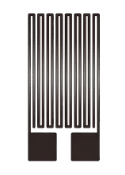
- Two University of Louisville studies [1], [2] demonstrate aerosol jet printing with JS-A426, including gauge design, sintering optimization, and gauge factor measurement.
- One University of Texas at San Antonio study [3] used JS-A102A, while a University of Novi Sad study [4] used inkjet-optimized NovaCentrix inks to rapidly fabricate varied sensor geometries.
- Two additional studies highlight applied systems: a delta robot with embedded strain sensing using JS-B25P [5] and a tactile robotic skin sensor using JS-A426 [6].
2. Introduction and Background
Strain gauges measure mechanical deformation by tracking how a conductive trace changes resistance under tension or compression. As the conductive path stretches or contracts, both the conductor geometry and the underlying microstructure shift, producing a measurable electrical response.
Traditional foil gauges remain effective, but they also come with real constraints: rigid mounting conventions, adhesive bonding steps, limited geometry freedom, and manufacturing overhead when a design needs to change quickly.
Printed electronics changes that design space. Conductive inks can be deposited directly onto flexible substrates, enabling software-level geometry changes, tighter iteration loops, and sensor fabrication on thin, conformal, or application-specific materials.
NovaCentrix offers multiple silver nanoparticle ink systems tuned to different deposition methods, from fine-line aerosol jet printing to production-oriented inkjet workflows. Those validated materials are what make the studies on this page relevant for engineering teams moving from concept to deployment.
Gauge Factor
Core sensitivity metric for strain gauges
Where ΔR is the change in resistance, R is the original resistance, and ε is the applied strain. A larger gauge factor indicates higher sensitivity.
Reference Range
3. NovaCentrix Inks for Strain Gauges
NovaCentrix conductive inks are engineered for digital deposition and post-print processing, supporting advanced manufacturing of printed sensors. Multiple silver nanoparticle inks have already been validated for strain-gauge applications across aerosol jet and inkjet workflows.
Metalon® JS-A426
AJP-optimized silver nanoparticle ink for fine-line printing on flexible substrates including PI (Kapton) and PET. Validated for tactile sensors, robotic skins, and structural gauges.
View JS-A426Metalon® JS-A102A
Silver ink for Dimatix drop-on-demand inkjet printing. Enables fast turnaround of varied sensor geometries on Kapton, reaching low resistance after staged low-temperature sintering.
View JS-A102AMetalon® JS-B25P
Silver nanoparticle ink for professional and desktop inkjet systems. Used in the delta robot origami joint sensing application with strong adhesion on PET.
View JS-B25PMetalon® JS-B25HV and JS-B15P
Inkjet inks validated on polyimide and PET across professional and desktop systems, with gauge factor values between 1.58 and 2.03 depending on substrate and layer count.
Browse Inkjet Inks4. Case Studies: Printed Strain Gauges Using NovaCentrix Inks
4.1 JS-A426 via Aerosol Jet Printing - University of Louisville [1], [2]
Two studies from the University of Louisville demonstrated the use of JS-A426 with aerosol jet printing to fabricate custom strain gauges on Kapton. The 2023 follow-up added a conductivity prediction model tied to sintering conditions, improving process control and reducing trial-and-error for new print conditions.
Key Results
Representative results for the JS-A426 aerosol jet studies.
| Printer | Optomec aerosol jet printer |
|---|---|
| Line width | 50 to 60 µm |
| Sintering window | 200 to 240°C for 18 to 24 hours |
| Conductivity | Approximately 7.05 × 10⁶ S/m |
| Gauge factor | 1.85 (2021) and 1.74 (2023) |
4.1.2 JS-A426 for Tactile Sensing on Flexible Substrates
This work extended JS-A426 into a star-shaped tactile sensor embedded in PDMS for robotic skins. Under roughly 5,000 cycles, the sensor maintained repeatable behavior with a gauge factor near 1.85, demonstrating durability in dynamic soft-robotics conditions. [6]
4.2 JS-A102A via Inkjet Drop-on-Demand - University of Texas at San Antonio [3]
The UTSA study used JS-A102A with a Dimatix drop-on-demand system to explore rapid sensor fabrication. Multiple geometries were printed on Kapton, producing resistances between 2.3 and 7.2 ohms after staged sintering at 50°C and 150°C. The result is a strong example of fast-turn prototyping with consistent electrical performance.
4.3 JS-B25HV and JS-B15P via Inkjet Printing - University of Novi Sad [4]
Researchers compared inkjet-printed strain gauges built with NovaCentrix silver inks across professional and desktop print systems. On polyimide and PET, the printed gauges delivered gauge factor values from 1.58 to 2.03 depending on substrate, ink selection, and layer count, while maintaining good short-term stability with only mild long-term drift.
5. Real-World Applications
Origami-Based Delta Robot
A team at Istanbul Technical University integrated printed strain gauges using JS-B25P into a foldable delta robot. [5] The sensors were printed on PET and embedded in origami joints for angle measurement, successfully tracking 0° to 90° motion via resistance change and enabling analog feedback for lightweight robotic control.
Tactile Sensing in Robotic Skins
A star-shaped strain gauge using JS-A426 was printed on flexible Kapton and embedded in PDMS to act as a tactile skin sensor. [6] The sensor showed linear, repeatable response under sinusoidal and step inputs, making it a strong fit for tactile feedback and soft-robotics integration.
6. Summary and Outlook
Across academic and applied studies, NovaCentrix silver nanoparticle inks have proven effective for fabricating high-performance flexible strain gauges using multiple digital printing processes. From aerosol jet to inkjet, and from Kapton to PET, the platform supports reliable conductivity, repeatable gauge factor performance, and integration into working robotic systems.
The ability to customize geometry, print directly onto flexible substrates, and work with relatively accessible deposition hardware makes these materials especially useful for rapid prototyping, wearables, structural health monitoring, and soft robotics.
NovaCentrix's broader materials portfolio and process ecosystem, including support for low-thermal-budget curing through PulseForge, provides a practical path from research validation to scalable manufacturing.
Future Directions
- Use photonic sintering for ultra-low thermal budget applications and heat-sensitive substrates.
- Combine strain sensing with adjacent functions such as temperature, pressure, or tactile response.
- Develop validated sensor-geometry libraries for faster OEM and research deployment.
7. References
-
[1]
Ratnayake, et al. Aerosol Jet Printed Strain Gauges Using Silver Nanoparticle Ink. IEEE Flex. Electron. Sens. Conf. (FLEPS) 2021.
Open source -
[2]
Ratnayake, et al. Conductivity Prediction for Aerosol Jet Printed Silver Nanoparticle Inks. IEEE J. Flex. Electron. 2023.
Open source -
[3]
Dipon, et al. Drop-on-Demand Inkjet Printing of Strain Gauges Using Silver Ink. Ferroelectrics 2023.
Open source -
[4]
Zlebic, et al. Performance Analysis of Inkjet Printed Strain Gauges on Flexible Substrates. Facta Univ., Ser. Electron. Energ. 2016.
Open source -
[5]
Kalafat. Origami-Based Delta Robot with Integrated Printed Strain Gauges. Hittite J. Sci. Eng. 2022.
Open source -
[6]
Olowo, et al. Aerosol Jet Printed Star-Shaped Strain Sensor for Robotic Tactile Skin. IEEE J. Flex. Electron. 2023.
Open source
Image credit: strain-gauge illustration adapted from the figure source currently used on this page, attributed under CC BY-SA 2.5. Back to top